Political Ideologies - The French Revolution

"On the morning of July 14, 1789, a crowd of Parisian workers set out to attack the royal prison of the Bastille. Joined by deserting soldiers who brought cannons, and ignored by Royal Army troops camped nearby, the crowds forced their way into the fortress by late afternoon, killing the governor and parading his head on a pike. That evening King Louis XVI reportedly asked a duke, "is this a revolt?" To which the duke replied: "No Sire, it is a revolution"" – excerpt from J. A. Goldstone's book, Revolutions, A Very Short Introduction.

In the second episode of this series, we continue to blend into our topic of Political Ideologies through French Revolution. Hope is to present a succinct summary of the events, and then proceed to ask the mammoth question, 'Why?' Welcome to Hitchens' Razor!

Someone had noticed that it is hard to talk about the French Revolution, not for the lack of resources, because there is a plethora of it. So, before we begin the revolution, may I regurgitate our gratefulness to the following authors for their great work on the topic, which has immensely helped us to tell the tale.

  1. Georges Lefebvre, The French Revolution, translated to English by Elizabeth Moss Evanson
  2. William Doyle, The French Revolution, a VSI
  3. Jack Goldstone, Revolutions VSI

and a shout out to Jawaharlal Nehru for 'The Glimpses of World History', and H.G.Wells as well for 'A Short History of the World'.

Although the narrative is simplified to be retold as a lucid story, there are many places where we have directly quoted from some of the above authors without saying so. We hope to leech on your ample-supple magnanimity to forgive us.

Shall we?

The Story

Our story begins in 18th century of the Common Era.

France's attempt to remain a global super force meant waging war with other kingdoms. They fought all over the world, at both land and the sea, in America, in Asia, and in native Europe. Engaging in relentless war means destruction; destruction calls for rebuilding; rebuilding costs money. During hard times, money demands either financial discipline or bankruptcy. For France, it was the latter. They were running out of money.

How did the French fund these wars in the first place? Well, the Finance minister borrowed money from Freemason banks and wealthy individual financiers of Europe. Wait, was there a system of government? Yes! It is what we now call the ancien regime. Under ancien regime the French society was then classified into three orders: The nobles(wealthy and powerful), The clergy(God people), and the Third Estate, i.e. everyone else. <beat> Geographically, France was divided into provinces, and there were courts or parlements for each province. The parlements were judicial bodies with around 1100 judges nationwide. The members of the parlements were aristocrats or nobles who had bought or inherited their offices, and were independent of the king. They wielded decision making powers on a wide range of subjects. Apart from this, the king had his ministers to take care of the kingdom's affairs. Okay, back to funding wars. For France, supporting the American war of Independence to defeat the British was dear. They had availed loans to enable the military, and borrowed even more money to pay off the arrears. <beat> Such was the deficit in August 1786, the Finance minister sent a letter to the king mentioning the need for a state reform. It was first of its kind act for France. Things turned worse in the following year; so much that in March 1788 the first budget of the old regime was needed to be drafted. Oddly enough, this was also the last budget of the old regime. It estimated a 20% deficit at 126 million livres. More than half of the expenditures were attributed to paying debts alone. <beat> The taxes in the country was already high, so raising taxes further to clear the arrears was out of the question. There existed a solution to the problem though, that is to bring equality of taxation for different classes of people and provinces of the country. <beat> And that's how it all began!

Shall we move on from the state of economics to the state of people? French revolution could be broadly divided into three stages. The Aristocratic revolution, the Bourgeoisie revolution, and the Popular revolution. We shall begin with the Aristocracy's quarrel, that is the Nobles' and Clergy's quarrel with their king.

At the verge of bankruptcy, the finance minister proposed new measures to raise funds. This included:

  1. A direct land tax upon all landowners without any exception
  2. Other taxes to be shared out without distinction as to order or class
  3. Freeing the grain trade from all controls, by abolishing internal customs barriers
  4. Asking clergy to clear its debt by selling the Church's manorial rights

The good minister thought that financial stability would strengthen his king's royal power, and reduce the opposition from parlements. The King Louis VI was a weak monarch; <beat> he had very little power and control over the country's affairs. He was considered almost a laughing stock of his courtiers and all those who had heard the stories. Aware of this status, the finance minister used indirect methods to get the tax reforms done. He convoked a meeting with the representatives of aristocrats and the clergy, also known as the Assembly of Notables to discuss the reforms. He expected the Notables to agree to the changes because of the economic condition of their kingdom. But this move backfired, as it amplified the frailties of the king, and it angered the Notables even more, as they thought it was an attack on their powers and rights. They rejected the proposal and after some internal politics the finance minster was dismissed. The replacement minister soothed the aristocracy by retracting the proposal, and instead offered to increase the stamp duty. But the Notables and the parlements rejected the new tax proposal as well, because this decision was not in their power, but was to be made by the wider group called Estates-General or the States-General representatives of France.

The debt remained, and the new finance minister was now desperate to raise money. Uncertain of the support from the parlements and aristocracy, he had the King pass an edict as a royal order superseding any opposition. Nevertheless, opposition duly came from a duke, and the duke was exiled by the King in retaliation. The parlements and lower tribunals and the aristocrats promptly protested, which turned violent at places. Tit for tat continued as the King started showing hints of despotism. The treasury was almost empty at this point amidst the mayhem, and the King finally gave away and dismissed the Finance minister again. The consensus pointed to the convocation of Estates-General for any tax related decision making. Like before, that is in 1614, the convocation was to have three orders representing the classification of the French society; The clergy, The nobles, and the Third Estate.

What you have heard until now is the revolution that happened in the background. The Aristocratic Revolution! The Nobles and Clergy against the monarch. The second part, which you are about to hear is called the Bourgeoisie Revolution.

The Third Estate, that is everyone else also contained the bourgeoisie. We have spoken a great deal about the rise of the middle class, i.e. the bourgeoisie in the previous episode. The news of gathering of the Estates-General sent tremors of excitement through the members of the Third Estate. Until then, they have had not seen much need for opposing the two classes above them. Suddenly the mood shifted. Many associations sprung up in this time - academies, agricultural societies, philanthropic groups, reading circles. They sought equality in the society thorough arguments of reason and natural right. Equality of taxation, and voting by heads rather than order was their major demands. Of course, the burden of the proposed new taxes fell disproportionately on the shoulders of third estate, when compared to the clergy and the nobles. Meanwhile the Nobles and the Clergy assured of their birth and divine rights, demanded a vote at the this meeting. Since Estates-General voted by order than by head, any two estates could outvote a third. This arrangement naturally favoured the upper classes. <beat> The mood of aristocracy during the French revolution is captured in this extract of a letter sent to the king by the royal princes.
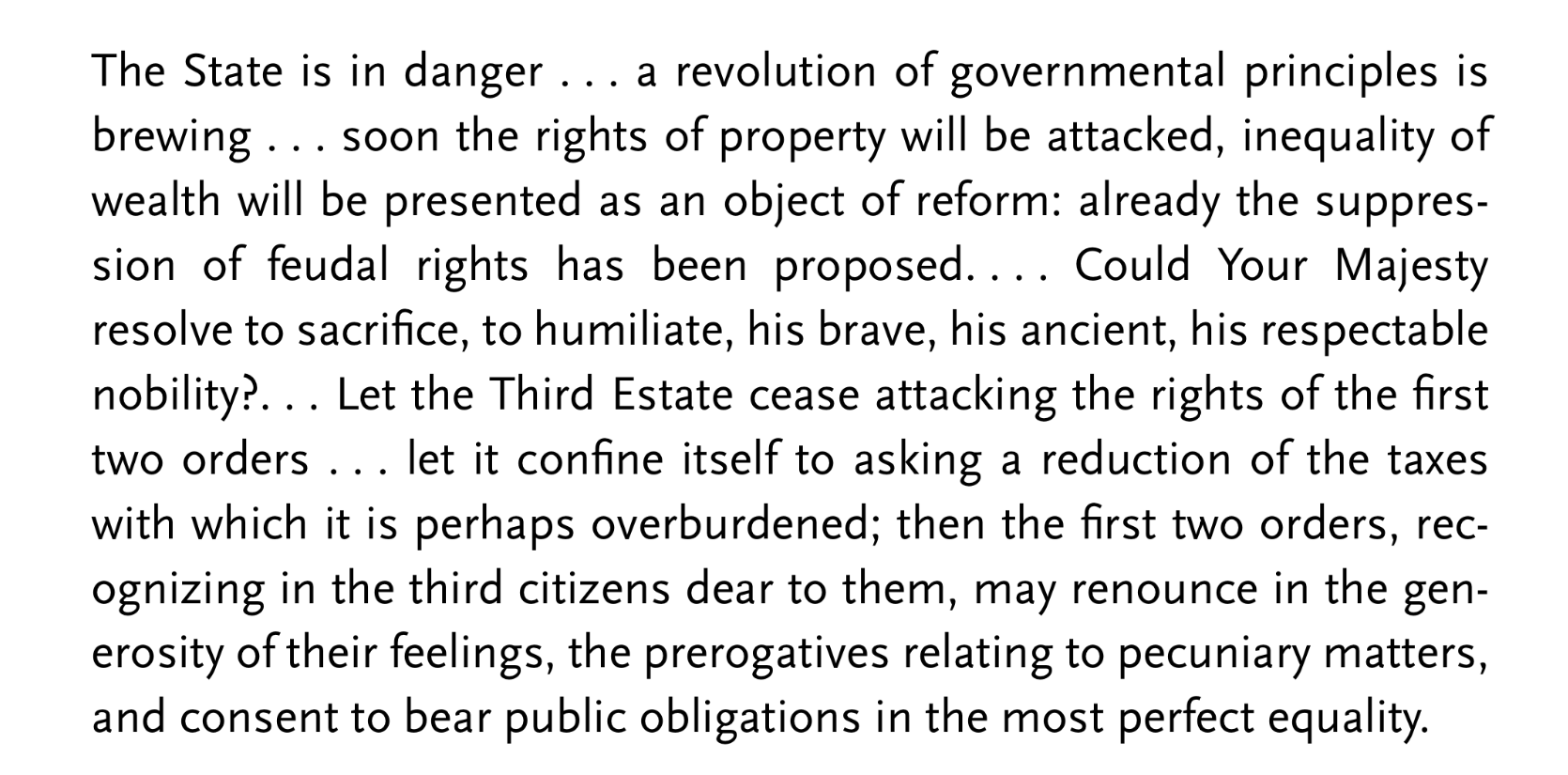

nil


Estates-General. France was all set for the rendezvous. A hotel was arranged for the meetings of the clergy and the nobility. A big national hall was arranged for the third estate to meet. All party meetings were to be held in a large room nearby. The nobles and clergy dressed in full regalia were seated on elevated platforms, whereas the third estate representatives dressed in black were seated on chairs at the floor level. On 5th May 1789, the proceedings began with a brief speech by the king. Then the finance minister harangued the audience, speaking at length about the financial situation with all sorts of boring details. He mentioned the proposed improvements of the situation, but omitted the subject of constitutional reforms, which everyone was desperate to hear. But he mentioned the voting would happen by order as before. There were serious opposition to this, but at that time the representatives didn't know each other well, so they proceeded with caution, and a delaying tactic was used. Stalemate continued where each order discussed further action in their allocated places. At the beginning, the Third Estate had taken a new name for itself; communes or, Commons. Not many knew that word evoked a vague memory of popular resistance to the feudal lords. For the Commons, they simply refused to be relegated to the third rank.

Few days later, the nobility, strong on its belief, announced themselves as a separate order. The Clergy meanwhile was in trouble because a large proportion of the parish church or the district church priests, supported the Commons. The bishops sensed imminent defection of the parish priests. So they requested the king to intervene. The King asked the conferences to be resumed at the common place, in the presence of his ministers. The finance minister further said that if no agreement could be reached, then the king's decision would be final. This put the Commons in a difficult position, but ironically the nobility rejected that royal arbitration proposal.

The Commons now invited privileged members to join them. Many parish priests did, but not one noble. With the new members the Third Estate's name was again changed to National Assembly. They demanded that all three classes be merged and voting shall be done by heads instead of order. They further claimed the power to consent to taxation. The nobility now ended their resistance towards the king and begged him to put the Third Estate back in line. But by now the majority of the clergy declared in favour of merging the three orders. Finally the finance minister came out and proposed equality of taxation and voting by heads. The King still hesitated. One fine day, the National Assembly, formerly known as the Commons, formerly known as the Third Estate discovered that the national hall where they met regularly to discuss their affairs was closed without any notice or warning. Certainly not defeated yet, they immediately convened in a Tennis court nearby, and took an oath to give France a constitution.

The king now disregarding his Finance minister, came up with his own declarations guaranteeing a constitutional system, civil liberty etc, but equality of taxation and voting by head was omitted. He then dismissed the assembly, but the members of National Assembly did not move. They said: "We will not stir from our seats unless forced by bayonets." Following this, many nobles also joined the commons, and the king eventually gave away and asked others to follow the suit. The legal, peaceful revolution of the bourgeoisie appeared victorious at this point. The nobles considered this as a humiliation, albeit not accepting defeat. The king on the other hand saw the members of National Assembly as rebels. First step, they had to get rid of the Finance minister who had supported the National Assembly's cause. He was dismissed arbitrarily and exiled. The bourgeoisie revolution seemed lost, but they were saved <beat> by the people, the proletarians, the peasants. That is the third part of the French Revolution, the Popular revolution!

We hope to talk more about the economic crisis and its effect in a later episode.

For the lower classes, the peasants and artisans the crisis plus the recent crop failure meant hunger and poverty. The hammer-crush burden of the nation's taxes fell on their thin shoulders. Bread was their staple, and it's prices kept increasing steadily. The old Finance minister had ordered large purchases from abroad, and labour camps were setup for distributing food. People, especially in the countryside were driven into desperation by the active tax collectors. The masses had to pay taxes, both direct and indirect, and thus pay for their own oppression. In all these the nobles and monarchy enjoyed their pomp and luxury. The hungry peasants of France were asked to eat grass by a governor. There were millions of professional beggars in France then. But the news of Estates-General kindled hope, a vision of future in them, especially since it had only happened two centuries ago. They thought, since the king consulted his people, he pitied their plight, writes Lefebvre. The great hope also inflamed fearful passions. The Third Estate was convinced that the nobles would stubbornly defend their privileges. The villagers thought the nobles would crush them using any measures. Foreign powers would be called to help put down the villagers. Meanwhile, in the background the dismissal of the good finance minister was seen as an act of aristocratic conspiracy. So they thought they should fight, taking up arms, releasing prisoners and recruiting them, forming their own army against the nobles. The king and the courts thought they should react to this social hullaballoo to keep things under control. Suddenly the capital city was filled with 20000 soldiers, much of them were foreign mercenary troops. That's that! When a German troop tried to disperse crowd in Paris, the hungry citizens decided to act, and French guards and military decided to help the people. They started ransacking the strong points in the city for Guns and food. Storming into a prison, releasing its inmates, and brutally killing the guard commander who had earlier ordered to fire on them, the taking of Bastille was complete. The fall of Bastille.

This quote from William Doyle's French Revolution sums up the episode, "The National Assembly had seized sovereign power in the name of the France Nation. It was the founding act of the French Revolution. If the Nation was sovereign, the king no longer was."

The National Assembly was indirectly helped by the proletarians and the peasants, and other hungry people of France. One thing to remember is that none of these happened overnight. For instance, the convocation of the Estates General was in fact proclaimed in mid 1788, whereas the revolution officially kicked off a year later in 1789. The economic and political crisis is said to have begun at least an year earlier before the proclamation of Estates-General in 1787. It's funny, that Bastille prison only had 7 inmates when it was stormed. It rather shows the fall of a symbol of royal power and pride, and the release of new ideas. The politics of social antagonism which started in Paris have had now spread to the countryside. The whole feeling later was transcended into paranoia of loss. We shall stop our narration of the French revolution here. As they say, the rest is history! That in summary includes:

  1. Abolition of privileges
  2. October Days, when a group of women marched to Versailles to escort the King to Paris, the epicentre of revolution.
  3. Church property nationalised
  4. Nobility abolished
  5. Parliament abolished
  6. Civil constitution for Church, i.e. a common platform for Catholics and Protestants
  7. War with neighbours
  8. Liberty Fraternity Equality
  9. Monarch executed in 1793
  10. Massacres
  11. Napoleon

and much, much more if you wish to zoom in, enough content for another series. But now we must stop and try to identify links to Political Ideologies.

മനസ്സിറങ്ങിയോടി

യാത്രയുടെ തുടക്കത്തിൽ എവിടെയെങ്കിലും ഒന്ന് തേങ്ങയുടയ്ക്കണം എന്ന് തോന്നി. സ്വീകൃത യാദവകുല മുരളീഗാന വിനോദ മോഹനകര. പഠെ! അവിടെ തന്നെ ഉടച്ചു നാളികേരം. കർപ്പൂരവും കത്തിച്ചു. കുറച്ചുനേരം ഗമധനിസ-യിൽ വട്ടത്തിരിഞ്ഞു. പിന്നെ നിമ്നോന്നതമായ ആ സ്വരങ്ങളിൽ അങ്ങോട്ടും ഇങ്ങോട്ടും നടന്നു. ഒരു തേങ്ങാപ്പൂളെടുത്ത് കീശയിലിട്ടു. സന്തോഷായി. നേരെ വിട്ടു വടക്കോട്ട്.

ആര്യവർത്തത്തിന്റെ ചരിത്രത്തെപ്പറ്റി ആലോചിച്ചു. ആരൊക്കയോ വരുണു. എവിടോയെക്കൊയോ പോണു. ഉള്ളതിനെ പൊളിക്കുന്നു. പുതിയത് പണിയുന്നു. സങ്കൽപ്പത്തിന് ഒറ്റപ്പേര് മതിയെന്ന് വാദിക്കുന്നു. ആ പേരിൽ ചറപറാ ഹിംസിക്കുന്നു. അതിന്റെ ഇടയിൽ, ഹൈ! മാൽകോൺസ് അല്ലേ ആ കേൾക്കുന്നത്. കുറച്ചുനേരം ഗമധനിസ-യിൽ വട്ടത്തിരിഞ്ഞു. സംഗീതമെങ്കിലും രക്ഷപെട്ടല്ലോ എന്ന് കരുതി ഗുരുക്കന്മാർക്ക് മനസ്സിൽ മുറുക്കാൻ മേടിച്ചുകൊടുത്ത് നേരെ തെക്കോട്ട് തീവണ്ടി പിടിച്ചു. ജനലിന്റെ അരികിൽ ഇരുന്നു കാറ്റുകൊണ്ട് ഉറങ്ങി.

ചുറ്റും പല ഉപകരണങ്ങൾ ചിലയ്ക്കുന്നു. മനസ്സിനെ നാല് അശ്വിനികൾ നാലുഭാഗത്തേക്ക് വലിക്കുന്നു.
എന്റെ കൈകാലുകൾ വിടൂ. നിങ്ങൾക്കെന്ത് വേണം പറയൂ.!
നിന്റെ സമയം. അതാണ് ഞങ്ങൾക്ക് വേണ്ടത്.
കടവുളേ, കാലനാണല്ലോ കാലം ചോദിച്ച് കാലുപിടിച്ചു വലിക്കുന്നത്. പക്ഷെ എവിടെയോ ഒരു പരിചയം. ഓ, കാലനല്ല, വിശപ്പാണ്. ചിന്തകൾക്ക് ഭക്ഷണം വേണം. ഉപകരണങ്ങൾ കയ്യിലെടുത്തു. എവിടെയൊക്കെയോ കയറി വാരി വലിച്ചു തിന്നു. മനസ്സിന്റെ ഭക്ഷണരീതിയിൽ ചിട്ടവരുത്തേണ്ടതിനെ കുറിച്ച് അദൃശ്യവൈദ്യന്മാർ ആഞ്ഞുപദേശിച്ചതിനെകുറിച്ചോർത്തു. 'ഹെൽത്തി' എന്ന് പേരുള്ള ഒരുതരം ഭക്ഷണം മാത്രമേ തിന്നാവൂത്രേ. മധുരമത്രെയും ഒഴിവാക്കണം. പക്ഷേ ഈ മനസ്സിന് ഇനിയും ഹെൽത്തിയാവാൻ സാധിച്ചിട്ടില്ല. ഭഗീരഥേട്ടനെ ഒന്ന് പ്രസംശിച്ചു. രുചിയുള്ള, വറുത്തുപൊരിച്ച, പൊരിച്ചുമൊരിച്ച, പഞ്ചസാരതൈലത്തിൽ മുക്കിയ ഇത്രയധികം വസ്തുക്കൾ ചുറ്റും മീഡിയകണക്കെ നിറഞ്ഞുനിൽക്കേ, ആർത്തിയെ ബന്ധിക്കേണ്ടതുണ്ടോ? ചോദ്യം തന്നോടുതന്നെ. പക്ഷേ, അങ്ങനെ ലോഭങ്ങളെ പൂട്ടിയ ആളുകൾ പുസ്തകങ്ങളെഴുതുന്നുവെത്രെ. പടി പടിയായുള്ള ഉപദേശങ്ങൾ നിറഞ്ഞ ഒരു മുത്തുച്ചിപ്പി. ഈ പുസ്തകം വായിച്ചാൽ സ്വയം സഹായിക്കാൻ പറ്റുമെത്രെ. ഭഗീരഥേട്ടനെ വീണ്ടും പ്രസംശിച്ചു. ങ്ഹാ, എന്തായാലും ഈ വരുന്ന തിങ്കളാഴ്ച്ച തുടങ്ങാം.

ദാ, ഒരു നിശാശലഭം. എവിടെ? പോയോ? പോയി.
അതെന്താ അവിടെ? മലയുടെ മുകളിൽ.
അത് ചന്ദ്രൻ.
അയാൾക്കെന്താ അവിടെ കാര്യം?
നക്ഷത്രങ്ങളെ കൂട്ടി ഭൂമിയോട് യുദ്ധത്തിന് വന്നതാണെത്രെ.
എന്നിട്ടെന്താ ഒന്നും നടക്കാത്തത് ?
ഇപ്പോൾ സീസ്‌ഫയറാണ് വെടിനിരോധനം. ചർച്ചനടന്നുകൊണ്ടിരിക്കുകയാണ്
സൂര്യനാണ് വിഭീഷണന്റെ റോൾ.
അയാൾ ഈ പണിക്ക് പറ്റുമോ? കടലിൽ പാലമിട്ടാൽ, കടക്കുന്നത് വരെ രാമായണാ, പിന്നെ തേരാപാരായണാന്നാണ്.
ങ്ഹേ? ഞാൻ കേട്ടിട്ടുള്ളത് പാലം കടക്കുന്നത് വരെ രാമാ, കടന്നാൽ നീ പോമാന്നാണ്.
അതെന്തായാലും വേണ്ടില്ല, സംഭവം രാത്രിയായാൽ അയാൾ ചന്ദ്രന്റെ കൂടെയാണ്.
അതൊക്കെ മൂപ്പരുടെ വെറും തരികിടയല്ലേ. ഭൂമിയെയാണയാൾക്കിഷ്ടം. നീ നോക്കിക്കോ, അവസാനം ചന്ദ്രൻ ശശിയാവും, അല്ലെങ്കിൽ സോമൻ, തീർച്ച!
യുദ്ധം അപ്പൊ തീരൊ ?
ഏഹ്, യുദ്ധം എപ്പോഴും ഉണ്ടാവും. ഇഷ്ടപ്പടിക്ക്! ഇവരെല്ലാവരും കൂടി നമ്മളെയിട്ട് ഇങ്ങനെ കറക്കും അത്രതന്നെ.

ഇഷ്ടപ്പടിക്കോ? ഇതെവിടെയോ കേട്ടിട്ടുണ്ടല്ലോ. ദാ പാലക്കാട്. സുൽത്താൻപേട്ട ജംഗ്ഷൻ എത്തിയപ്പോൾ, വട്ടവും നോക്കി വരുംവരായ്കളുടെ ജക്സ്റ്റപൊസിഷൻ എന്താന്നെന്നോർത്ത് അമ്പരന്ന് നിന്ന പയ്യൻ വട്ടം ചുവപ്പിൽ നിന്നും ആംബർ ആയതറിഞ്ഞില്ല. പോലീസ്‌കാരൻ വാചാലനായി. പിന്നൊന്നും നോക്കിയില്ല. റോങ്ങ്ട്ടേണിൽ നേരെ ഹരിഹരപുത്രക്ക് വിട്ടു. ലക്ഷ്യം മാർഗ്ഗത്തെ സാധൂകരിക്കും എന്ന് പാർത്ഥസാരഥി പറഞ്ഞപ്പോൾ മൂപ്പർക്ക് വിശന്നു കാഞ്ഞിട്ടുണ്ടാവണം.

എന്താ ഏട്ടാ, സൂആംതന്നെ?
ഓ!
ദോശണ്ടാ?
ഇല്ല, റോസ്റ്റേയുളളൂ
വേറെന്താള്ള? സേവ, വട, ഇലയട, ഇട്ട്ളി, പൊറോട്ട, ചപ്പാത്തി, ഭൂരി
ഭൂരി മതി, 3 എണ്ണം.
കാത്തിരുന്നു. നല്ല ഭുസ്‌ക്ന്നുള്ള മൂന്ന് ഭൂരി വന്നു. ഭൂരി കരുണാകാര എന്ന് സ്വാതിയേട്ടൻ പാടിയതിന്റെ സംഗതി ഇപ്പൊ പിടികിട്ടി. ഭൂരിയുടെ പെരടികുറ്റിക്ക് നോക്കി ഒരു കുത്തുകുത്തി. കാറ്റ് പൊസ്ക്ക്ന്ന് പോയി. ഹിംസിച്ച പാപം ഭക്ഷിച്ചാൽ തീരും എന്ന ദാർശനികതയിൽ മസാൽ കൂട്ടി വലിച്ചുവാരി കഴിച്ചു. ഏട്ടൻ പിന്നേം വന്നു.

കാപ്പിട്ടോളിൻ. ശക്തൻ. പൻസാര വേണ്ട.
കാപ്പി ആറ്റി ആറ്റി കുടിച്ചു.

<എട്ടനുമായുള്ള ഗീർവാണം ഇവിടെ എഴുതാൻ ഒരു ഓർമപ്പെടുത്തൽ ഭാവിയിലേക്ക് രേഖപ്പെടുത്തി>

കടയിൽനിന്നിറങ്ങി. തത്തക്ക പിത്തക്ക നടന്നു. ഭയങ്കര സീണം. ഒന്ന് കിടക്കണം. അടുത്തുള്ള ഒരു വലിയ അമ്പലത്തിന്റെ കൽത്തിണ്ണയിൽ കിടന്നുറങ്ങി. ഉള്ളിൽ കയറിയില്ല. അശുദ്ധമാക്കേണ്ടെന്ന് മനസ്സ് സ്വയം തീരുമാനിച്ചു. പെട്ടെന്നെണീറ്റു. ഒരു അടുക്കും ചിട്ടയുമില്ല. വേറെവിടെയോ ആണല്ലോ നിന്നിരുന്നത്. ങ്ഹാ, മലമുകളിൽ, ഭൂമിയും, ചന്ദ്രനും, സൂര്യനും. യുദ്ധം. അല്ലെങ്കിൽ യുദ്ധം വേണ്ട. എന്നാ കടൽക്കരയിലേക്കു പോകാം. തീരത്തൂടെ നടക്കാം. ചക്രവാളത്തിന്റെ സ്ട്രക്ച്ചർ കണ്ടാസ്വദിക്കാം. ചാറ്റൽ മഴയുണ്ടാവും. നന്നായിരിക്കും.

ങ്ഹേ, ഒറ്റയ്ക്കോ ? മഴയത്ത് പ്രേമിക്കാൻ ആരെങ്കിലും കൂടെ വേണ്ടേ?
അതിനല്ലേ പഴയ കാമുകിമാർ.
കൊണ്ടുവന്നിട്ടുണ്ടോ?
ഓ. എപ്പോഴും കൂടെയുണ്ട്.

കൈകോർത്ത് നടക്കാം. ഓട്ടപ്പന്തയം വയ്ക്കാം. മുടിയിൽ പിടിച്ചുവലിക്കാം. തോളിൽ കയ്യിട്ടു ചെവിയിൽ ഉഫ്ന്നു കാറ്റൂതാം. അങ്ങനെയൊക്കെ സ്നേഹം പ്രകടിപ്പിക്കാം. പിന്നെ കവിത ചൊല്ലി ബുദ്ധിമുട്ടിക്കാം. അയ്യോ, കവിത മുട്ടുന്നു.

എഴുതാൻ വാഞ്ഛ!
പക്ഷേ, എന്റെ പേനക്ക് നീരിളക്കം വരുന്നില്ല.
നളിനി, നളിനകാന്തി, മായാമോഹിനി
മലയാളപദങ്ങളെ,
നിങ്ങളെ മോചിപ്പിക്കാൻ,
എന്നെ ആശ്വസിപ്പിക്കാൻ,
എനിക്കാശ്രയിക്കാൻ,
ആശയങ്ങളെവിടെ?
അശ്വാരൂഢസാഹിത്യയോദ്ധാക്കളെ,
ഗുരുക്കന്മാരെ,
അതികായരെ, എന്റെ അതിഥികളെ,
സരസസരസനായ ഈ പയ്യനെ സഹായിക്കൂ,
അനുഗ്രഹിക്കൂ,
എനിക്കെഴുതാൻ വാഞ്ഛ.

ഹാവൂ, ഒരു സുഖമുണ്ടിപ്പോൾ. ഇനി തിരിച്ചു പോകാം. ശിരോസ്‌ഥിക്കുള്ളിൽ വിശ്രമിക്കാം. വന്ന വഴി തിരിച്ചുനടന്നപ്പോൾ കുറച്ചു തേങ്ങാപ്പൂളുക്കൾ ചിതറി കിടക്കുന്നതു കണ്ടു. ഒന്നെടുത്തപ്പോൾ അതിലെന്തോ വരപ്പെടുത്തിയിരിക്കുന്നു. 'ഗ'. തൊട്ടടുത്തതിൽ 'മ'. പിന്നെ അടുത്തതിൽ 'ധ', പിന്നെ 'നി'. എല്ലാം ചേർത്തി വച്ച് വായിച്ചു. എന്തോ ഒരു കുറവ് സ്പഷ്ടം. ചുറ്റും പരതി, ആകാശത്തേക്ക് നോക്കി, ങ്ഹേ.. കിട്ടിയില്ല. പെട്ടെന്ന് ഉള്ളിലേക്ക് നോക്കി. സ്വന്തം പോക്കറ്റിന്റെയുള്ളിൽ. 'സ' കിട്ടി. അതിനെ പൊട്ടിച്ചു. ചെറിയ കഷണം ഇടതുഭാഗത്തും വലുത് വലത്തും വച്ചു. എന്നിട്ടു ചേർത്ത് തിരിച്ചും മറിച്ചും പാടിക്കൊണ്ട് നടന്നു.

സ ഗ മ ധ നി സ
സ നി ധ മ ഗ സുഭം.

Political Ideologies - The beginning

"Listen – strange women lying in ponds distributing swords is no basis for a system of government. Supreme executive power derives from a mandate from the masses, not from some farcical aquatic ceremony." says Michael Palin's character in the film Monty Python and the Holy Grail.

Well, in today's episode we begin the series of discourse about supreme power and masses and governments.

Political ideologies.

It's rather a difficult topic to discuss, isn't it? Where to begin, what to say, what not to utter, all those epoch defining events, everlasting personalities, textbook terminologies, its immortal influence in the past, present, and dare I say, the future! And such is the fatality of this topic that our original plan to discuss it under "Dumb it down to me" series, was deemed dumb unanimously. Like a live fish, the harder you try to grasp it, the farther it escapes. At any rate, an optimistic attempt is vital, so, Welcome, to Hitchens' Razor!

Liberalism, Conservatism, Left, Right, Fascism, Socialism, Communism, Libertarianism, Nationalism, Left of centre, Right of centre, uff, and yet, here we are; One has to wonder, how has these managed to remain relevant to the modern world?

Now, our attempt to be pragmatic in this episode, say, to rather talk about the juicy events of the past, than to be tediously academic, wouldn't mean that this episode would be any less boring than your current imagination. In fact, such a statement would be euphemistic to a fool's errand around a Mobius band. Such is the fatality of this topic. If you are not bored already,

Let's begin, by travelling back to a time when the word Ideology did not exist.

Recap of history

If we are to believe in contemporary consensus, then "Life began in the ocean". Some creatures subsequently crawled up to the landmass; the reptiles. They had sex, laid eggs, and abandoned them, moved on to next honey moon. Reptile nonchalance is criminally underrated.

Then came the birds. They developed wings and feathers to counter the cold. They had intercourse and more eggs were delivered. But unlike the reptiles, they started caring about their eggs; by keeping them warm under their wings and fuselage. The first act of true selfishness.

Enter mammals, with the hitherto unknown notion of storing eggs inside its own body, inside its own body!. Such was the shock, bird brains accomplished maximum cognisance, and reptiles simply looked up. Mammals also acquired the habit of providing protection and nutrition to the offspring. This created attachment between the youngling and the parent, and it kindled the possibility of learning by imitation. The beginnings of a true social life. As H.G.Wells put it, "A teachable type of life had come into the world". And thus we evolved!

Well, the point is, we evolved as a species from Reptiles and Birds to Mammals, to Hunter Gatherers; we had the early civilizations in Egypt, India, Mesopotamia and China. We had Aryans and Dravidians, the panchayat or the village system, the great thinkers Kong Fu-Tse(Confucious), Lao-Tse and Buddha. We had the kingdom of Persia, the great Greek period, conquests of Alexander, the Mauryan dynasty, Kautilya and Arthashastra, Hellenistic Greece, Ashoka, Rome, Carthage, Caesar, Pompey, Augustus, Cleopatra, Jesus of Nazareth, Constantinople, Holy Roman Church, the Orthodox church, Goths, Huns, Vandals, Islam, Xuanzang(Hsuen Tsang), Charlesmagne, The fall of Rome, Chalukyas, Pallavas, Rashtrakutas, Pandyas, Cholas, Ghazni, Genghis Khan, Marco Polo, Timur, Dark Ages, Crusades, the Renaissance, Age of Science, Age of Enlightenment, Age of Revolution, and then the FRENCH REVOLUTION happened.

1789

The word ideology was coined, literally a new ‘science of ideas’.

Thence we had Marx, Nietzsche, Electricity, Russian Revolution- part 1, WW- part 1, Russian Revolution - part 2, the Great Depression, WW-part 2, Electronics, Computers, Cold War, Globalization, Internet, Climate change, Covid and now, now, as in, the now, now-now, at the moment now.

Now, hopefully that painted a vague timeline of our history. Now, we slip on a banana peel and fall into the coming of ideologies.

The coming of Ideologies

It is in Europe where the seeds of modern political ideologies germinated at a time when politics revolved around religion and religion only. The idea of nationality which is obvious these days was rather a niche topic then. War was the most dangerous pandemic in the continent, and religion was the most important cog in the war machine. Christians, other Christians, Muslims, other Muslims endlessly fought and killed to protect their version of the supernatural.

Feudal System and the Middle class

Violence and disorder prevailed both internally and externally. Strong people seized land and power, and they built strong castles for own protection, as they were always under threat from people like themselves. The peasants were not organized and couldn't defend themselves, so they sold their allegiance to these lords in castles. The small lords served the bigger lords, and the big lords bowed to the monarch. The Feudal System!. The Church, and its officials were also part of this. The idea of equality or of freedom was exempted in this system. Thus the middle ages passed under feudal system where peasants lived miserably. There were occasional revolts from the peasants, but they were cruelly put down by the upper classes.

The bourgeoisie

There was also another type of people, a floating class including the traders and merchants. They were not part of the feudal system per se, but they had no wealth or influence in that society. But the discovery of sea routes radically changed the fortunes of these daring people. Sea routes opened markets far east and west of Europe. Asia, America and other parts of the world became accessible to them. The middle-class, aka the bourgeoisie thus gathered wealth from global trade, and the new money fetched them privileges, and eventually power. They still had two classes above them, the nobles and the clergy, and of course the king at the top. This segregation based on class is officially called the Ancien Regime, which had policies and taxation controlling the freedom of the tradesmen. Naturally this was increasingly becoming a hindrance to the bourgeoisie, as they disliked the fact that the classes above them got money without work, and representation without taxation.

Three 'R's

And then there were the three great movements of the era: Renaissance, Reformation, and Revolution. The renaissance was about learning, science, experimental rationalism and asking questions about the universe. Hopefully, more of Renaissance in another series. Now, Reformation was about religion, specifically Christianity, and of Revolutions, there were three.

Reformation

We shall start with the Reformation.

Printing! The Arabs learned paper-making form the Chinese, and Europe learnt it from the Arabs. Towards the end of 15th century, paper and printing became common. This meant common people could read books themselves, didn't need a priest to tell them the content of the Bible.

Rome was the epicentre of European Christianity in this era. At some point the Roman Church thought heresy hunting would be a fabulous idea. Apparently, there was fun to be derived and lessons to be taught by burning people alive at stakes if they questioned the ways of the church. Women were branded as witches and burnt alive publicly. The infamous Spanish Inquisition formed during this time, epitomised this sport by underlining the word hunting in heresy hunting. Many more heinous crimes of unspeakable nature were committed in this time by the self appointed guardians of god and faith. Early in the 16th century, Martin Luther, a Christian priest visited Rome, and he was disgusted by its corruption and luxury. He was a leader who protested against the Holy Roman Church, and thus formed the christian faction Protestants, against the Roman Catholic, RC. This Protestant movement gathered pace when young princes and nobles sided with the protestants to put an end to all attempts made by the Pope to dominate over them.

In England, Henry VIII, favoured the protestants because he wanted to divorce his wife and marry another woman, which the Roman Catholic Church, naturally, was against. So he formed another church called the Church of England, and established himself as the Head of the Church, and married the woman. He was then the head of the state and head of the church. Well, why not? god is omnipresent isn't it?

Italy, France, Austria, and Spain were Catholic at the time. Germany was half protestant. The middle class carried the Protestantism with them; wherever they were strong, protestants thrived. But reformation was not enough to bring down the kings, they were still powerful and autocratic as ever. The monarch remained, and waited for the revolutions.

Netherlands, Switzerland and England

Before we get to the three big revolutions it is worth mentioning Netherlands, Switzerland and England. Netherlands became republic even before the French Revolution. There was a heroic but bloody battle that happened between the merchant classes bourgeoisie of Holland and King Philip II of Spain, who at that time ruled the region. Switzerland also gained independence around this time from the Holy Roman Empire after the Thirty Years war.

England, had the parliament in place with two houses, mostly represented by the lords and nobles at the upper house, and the merchants and wealthy middle class in the lower house. The parliament eventually became stronger than the monarch, at a point where its King was beheaded at the orders of the parliament, only to be later replaced with a puppet from elsewhere in Europe, Germany I think. England is a curious case, where the Gentlemen and the Bourgeoisie joined to share power with the king.

The Three Revolutions

It is interesting that three revolutions happened broadly around the same time in history. The political revolution in North America, the industrial revolution in England, and the social revolution in France.

American Revolution

War is so demanding, it exhausts the resources of a kingdom, which in turn demands from its masses, more suffering that is.

For the British Government, the umpteenth war with France meant need for more money, and they decide to squeeze the colonies to breakeven. The American colonies resisted, and when the British East India Company tried to force the colony to buy their tea, the colonists boycotted the act, and some colonists threw the tea overboard from the ships. Cut to war scenes where France helped the American Colonists. Cut to British accepting defeat. Cut to the signing of the Declaration of Independence, with the famous cry, No taxation without representation. The declaration also said, "All men are born equal" <beat/pause> except the negroes.

and, in the next episode, The French Revolution.

Curses and Chances

The curse is upon all of us.
But we are not at faults!
To collect thoughts and connect dots.

Curse of love, my love,
Curse of care, brother,
Curse of bond, my friend,
Blood, kin, and beyond.

But, for every curse, there is a chance,
That might seem second at first,
but for a lifetime it will stick with us,
Only if we embrace it at self behest,
Alike the tale of hare and tortoise.

Hitherto, we lived in parallel lines,
Belated, your smile crossed mine.
Then we spoke, and we laughed,
And then we sang, and we danced.
We are thus aware that we were,
For our purpose, joie de vivre!

There are only poems, no poets,
Art owns its own artist.
A deaf maestro's lullaby,
That we could finally,
Feel the friend in you and me,
Where serendipity serenades to our vivacious youth,
And the greatest relief lies in telling the truth.

എന്റേതുമായിരുന്നു

പടിപ്പുറത്തേക്ക് നോക്കിയാൽ കാണുന്നത് ടാർ റോഡാണ്. ഗ്രിഗോറിയൻ കലണ്ടറിൽ ഇന്ന് പുതുവത്സരം. ചിന്തകളടക്കാനാവാതെ പടിപുറത്തേക്കുനോക്കി ചാഞ്ഞുകിടന്നപ്പോൾ കണ്ടത് സ്കൂൾ കുട്ടികളെയാണ്. അവർ ഇന്നും യൂണിഫോം ധരിച്ചിരിക്കുന്നു. ഇന്നവധിയല്ലേ? ആത്മഗതത്തിൽ തന്നെ ഉത്തരവുമുണ്ട്. ഇളം നീല ഷർട്ടുകൾ. ട്രൗസറിന്റെയും ഫ്രോക്കിന്റെയും നിറം ഓർക്കുന്നില്ല. കുട്ടികൾ നടന്നു ചുമരിൽ അലിഞ്ഞു.

അവർക്കു പിന്നിൽ വന്നത് ഒരു മൂരിവണ്ടിയാണ്. ഒഴിഞ്ഞ വണ്ടി, വൃദ്ധൻ വണ്ടിക്കാരൻ. തൊട്ടുപിന്നാലെ രണ്ട് മൂന്ന് ആൺകുട്ടികൾ വേഗത്തിൽ നടക്കുന്നു. വണ്ടിയിൽ ചാടികേറിയിരുന്ന് പോകാനാണ് ശ്രമം എന്ന് മനസ്സിലായി. അവർക്കു കുറച്ചുപിന്നിലായി കൂട്ടത്തിൽ തന്നെയുള്ള രണ്ട് പെൺകുട്ടികളും ഒരാൺകുട്ടിയും മെല്ലെ നടന്നു വരുന്നു. അവനാണോ പഠിപ്പിസ്റ്റ് ?

മൂരി ചുമരിൽ മറഞ്ഞു. വൃദ്ധനും പോയി. പിള്ളേരും. ഓർമ്മ, അത് പഴയകാലത്തിന്റെ സമ്പാദ്യമാണ്. പതിഞ്ഞസമയത്ത് അതിനു മനസ്സിൽവലിയ പ്രാധാന്യമില്ല. പക്ഷേ ഇന്നു ഞാൻ മങ്ങിക്കണ്ട ആ പഴയചിത്രം. ഞാൻ അറിയാതെ ചിരിച്ചുപോയി.

ഞാൻ ചാടിക്കേറാൻ ശ്രമിച്ച മൂരിവണ്ടി എന്റെ മനസ്സിലേക്ക് വന്നു. ഓടുന്ന വണ്ടിയുടെ വേഗത്തിനൊപ്പം ചലിച്ച്, ആ ഉത്തമമുഹൂർത്തത്തിൽ പുറക്കോട്ടുതിരിഞ്ഞ്, കൈകൾ വണ്ടിയുടെ പലകയിലമർത്തിയൂന്നി, ഇടയിലൂടെ അൽപനേരം വായുവിൽ സഞ്ചരിച്ച് പിൻഭാഗം പലകയിൽ തട്ടിയപ്പോൾ മുന്നിൽ നടന്നകലുന്ന കൂട്ടുകാരുടെ മുഖത്തെ ചിരി എന്റേതുമായിരുന്നു.

ചിത്രം പത്രത്തിൽ

ഇളം കാറ്റ്.

ഒരു കൈയിൽ കണ്ണട, മറുകൈയിൽ പത്രം. അച്ഛൻ വരാന്തയിലേക്ക് വന്നു. ഒറ്റമുണ്ട്, വെള്ള ബനിയൻ, ആവശ്യത്തിലധികം ഭസ്മക്കുറി. ആകെമൊത്തം ധവളാഭം. കണ്ണടയിട്ട് കസേരയിലിരുന്നു. എന്നിട്ട് പത്രത്തിന്റെ മേൽത്തലപ്പിലൂടെ മുറ്റത്തേക്ക് നോക്കി. അമ്മ പൂജയ്ക്ക് പൂപറിക്കുകയാണ്.

അച്ഛൻ : ഭവതി പൂപറിക്കുകയാണെന്ന് കണ്ടറിയുന്നു.

അമ്മ : ഹോംസിന്റെ നിരുപമമായ വീക്ഷണബുദ്ധിയെ ഇന്ന് വീണ്ടും ഞാൻ അഭിനന്ദിക്കുന്നു.

അച്ഛൻ : നന്ദി പറയേണ്ട ഈ അവസരത്തിൽ ഇങ്ങനെ ചൊല്ലുന്നത് ശരിതന്നെയോ എന്നറിയില്ല.

അമ്മ : ശരിയല്ല.

അച്ഛൻ : എങ്കിലും…, പത്രവും ചായയും. അതല്ലേ കേരളീയരുടെ മൗലികാവകാശം? പത്രവായനേന തേയിലപാനീയനേന എന്നല്ലേ ഗുരുവാക്യം.

അമ്മ : രാവിലെതന്നെ വേണോ ലോ-കീ ഗീർവാണം? ഭഗവാന് പുഷ്പ്പാർച്ചന, ശേഷം ഭർത്താവിന് ചായ.

അച്ഛൻ : ദൈവത്തിന് പൂകൊടുക്കാൻ വേറെ എത്രയോ മഹിളകൾ ഈ നാട്ടിലുണ്ട്. എനിക്ക് ചായ തരാൻ നീ മാത്രമല്ലേയുള്ളു.

അമ്മ : അറിഞ്ഞതിൽ വളരെ സന്തോഷം.

അച്ഛൻ : "ദാറ്റ് വാസ് എ ഗുഡ് വൺ".

(അച്ഛൻ വായന തുടരുന്നു. അമ്മ അകത്തേക്ക് പോകുന്നു.)


അച്ഛൻ : അതേ…

അമ്മ : ദാ വരുന്നു.

അച്ഛൻ : ചായ വേണ്ട. ഒന്നിങ്ങോട്ടു വരൂ.

(ഭയങ്കര നിശ്ശബ്‌ദത. പിന്നെ കാലൊച്ച.)

അമ്മ : "ചന്ദ്രനിലും ഗുരുത്വാകർഷണം, മലയാളിക്കിന്നു ചായ വേണ്ട", എന്നാണോ പ്രധാനവാർത്ത?

അച്ഛൻ (പത്രം നീട്ടികൊണ്ട് ) : ഹ്രസ്വഹാസ്യം മതിയാകൂ, എന്നിട്ടിത് നോക്കു. അറിയോ ഇയാളെ?

അമ്മ : ഇത്…

അച്ഛൻ : അതെ, നമ്മുടെ മോൻ തന്നെ.

അമ്മ : ഇവനെങ്ങനെ…

അച്ഛൻ : വായിക്കാം. കേട്ടോളൂ.

പാലക്കാട് : പേരുവെളിപ്പെടുത്താനാഗ്രഹിക്കാത്ത പാലക്കാട്ടുകാരൻ പയ്യൻ അതീവ സുന്ദരനാണെങ്കിലും, മാതാപിതാക്കളുടെ സന്തോഷം ആഗ്രഹിക്കുന്നവനാണ്. സ്വന്തം ചിത്രം പത്രത്തിൽ കൊടുക്കാനുണ്ടായ സാഹചര്യം പയ്യൻ ലളിതമായി വിവരിക്കുന്നു. കഴിഞ്ഞാഴ്ച്ചയാണ് യൂണിവേഴ്സിറ്റി പരീക്ഷാഫലം വന്നത്. അതേ ആഴ്ചതന്നെയാണ് ചേച്ചിയുടെ റാങ്ക് വിവരവും, ഫോട്ടോയും പത്രത്തിൽ വന്നത്. ലഡ്ഡു ഭക്ഷിക്കുന്നതിനിടയിൽ പയ്യനേയും, പത്രത്തേയും, ചിത്രത്തെയും ഒരേവാക്യത്തിൽ അച്ഛനമ്മമാർ പ്രയോഗിച്ചു. പയ്യനിനിയും പല പരീക്ഷകൾ പാസാവാനിരിക്കുന്നതേയുള്ളു. എങ്കിലും അവരുടെ ആഗ്രഹസാഫല്യത്തിന് വേണ്ടി അല്പം പ്രയത്നിക്കണമെന്ന് പയ്യന് തോന്നി. അതിനുവേണ്ടി എന്നത്തേയുംപോലെ പയ്യൻ അമ്മയുടെ പേഴ്സിൽ നിന്നും അമ്മയറിയാതെ രൂപ കടം വാങ്ങി. അമ്മേ, അഭിപ്രായസ്വാതന്ത്രത്തിനിന്നു നമ്മുടെ നാട്ടിൽ വലിയ വിലകൊടുകേണ്ടതുണ്ടെന്ന് ഞാൻ മനസിലാക്കുന്നു. ഇനിയും കുറേ എഴുതണം എന്നുണ്ട്, പക്ഷേ ഫോട്ടോയുടെ വലിപ്പം കുറയ്‌ക്കേണ്ടിവരും എന്ന് ഈ ഉണ്ടക്കണ്ണൻ പറഞ്ഞത് കൊണ്ട് നിർത്തുന്നു . ഇൻക്വിലാബ്.

അമ്മ : ഇവന്റെ കാര്യത്തിൽ നമുക്ക് കുറച്ചുകൂടെ സൂക്ഷിക്കാമായിരുന്നു.

അച്ഛൻ : "പലാനാം പലവിധാനാം, ബഹ്വാനാം ബഹുവിധാനാം, അതിലൊരു വിധാനാം".

ചിന്താമഗ്നനായി

മനസ്സിന്റെ സന്തുലിതയെ തകർക്കാൻ വിശപ്പിനു സാധിക്കും. ഇതല്ല, വേറെന്തോ എഴുതാനാണ് ഉദ്ദേശിച്ചത്.

മനസൊരു കുളമാണെന്ന് കരുതി. അതിലേക്കു നീട്ടി എറിഞ്ഞ ഒരു പരന്ന കല്ല് പോലെ ആശയം തെന്നി തെന്നി ദൂരെ മറയുന്നു. പക്ഷേ അതൊരിക്കലും അക്കരെയെത്തുന്നില്ല. ജലാശയത്തിനു നടുവിൽ ആശയത്തിന്റെ പയനം പര്യവസാനിക്കുന്നു. പിന്നീട് എപ്പോഴോ ഒരു പഴയ ഓർമ്മ കൊളുത്തിയ പുതിയ ആവേശത്തിൽ, ആ ജലാശയത്തിലേക്കു നാം എടുത്തു ചാടുന്നു. മുങ്ങി നീന്തി ആശയത്തെ പുറത്തു കൊണ്ടുവരാൻ ശ്രമിക്കുന്നു. നീന്തി നീന്തി കുളത്തിന്റെ നടുവിലെത്തുമ്പോൾ, അവിടെ ഒരു ആശയദ്വീപ്! ചെറിയ പരന്ന കല്ലുകൾ കൊണ്ട് രൂപപ്പെട്ടിരിക്കുന്ന ഒരു അതിശയദ്വീപ്. ഓരോ കല്ലിലും തന്റെ കയ്യൊപ്പ് പതിഞ്ഞിരിക്കുന്നു. അതുകണ്ട് ആദ്യം ഒന്ന് അന്ധാളിക്കുന്നു, ഞാൻ താൻ തന്നെയോ ഇത് എന്ന് ചിന്തിച്ച്‌ ഉറ്റുനോക്കുന്നു. വലിച്ചെറിഞ്ഞ ആശയങ്ങളുടെ ഇടയിൽ നിന്നും ഒരു ചെറുപുളകം കുളിർപ്രവാഹത്തിലൂടെ തന്നെ തലോടുന്നു. മന്ദഹാസപുഞ്ചിരി ചുണ്ടിൽ വ്യാപിക്കുന്നു. സ്വാഭിമാനം രോമാഞ്ചമണിയിക്കുന്നു. ആശയത്തെ വീണ്ടും ഉപേക്ഷിച്ച്, വികാരം മാത്രം ഉൾക്കൊണ്ട് ഉപരിതലത്തിലേക്ക് ഉദിച്ചുയരുന്നു. വിടർന്ന ചുണ്ടുകളിലൂടെ ഒരു ചോദ്യം, ഇനി എന്ത്?

ഇതല്ല, വേറെന്തോ എഴുതാനാണ് ഉദ്ദേശിച്ചത്. എന്തായാലും അടുക്കള വരെ ഒന്ന് പോയി നോക്കാം.

Acting

Curiouser and Curiouser gets life at every random decision we make. I was labouring under the delusion that by not bothering to give a try at something, one was assured to be bad at it. If these words were short and catchy, it would have become my motto. Does that make any sense? Life is Schrodinger's cat all over again.

Bit of background, I moved to a different country to pursue the ever elusive higher education. Call it the autumn madness, I enrolled for an audition at the University's drama society. My first audition. All I wanted was to experience the process, and to mildly irritate the panel with uncouth improvisations. I auditioned for the role of Guy Tree, a homeless person carelessly wandering into a farm owned by two sisters. The sisters had inherited the farm from their recently deceased parents. Sisters adopts Guy Tree into their farm and household, and he helps them in managing the farm. I was asked to deliver a monologue of Guy Tree reminiscing his past; living in a busy city with his parents, and him wanting peace and quiet. When he eventually reach the farm which is extraordinarily quiet, he finds the silence intolerable. Done. We will let you know in couple of days. Two days later, I got a recall from the team.

Having no expectations is perhaps our greatest courage to attempt out of the ordinary deeds. And when someone identifies the petite potential in us, that discovery becomes the worst form of scaremongering. I was nervous going into the recall auditions because, around 80 members auditioned for this in the first round. Majority of them belonged to related fields of study, like Literature, Drama Studies, Gender Studies, Film Studies etc. I was an Electrical Engineer. Regardless of the outcome, I convinced myself to enjoy the experience.

Ben, brother of the two sisters running the farm comes into the play. Freddie played Ben's character. I played Guy Tree. A lengthy conversation between the generally insecure yet extroverted Ben, and the optimistic but introverted Guy was to be enacted for the recall auditions. After practising couple of times, we went into the audition room. The panel were ready when we were ready. For the fifteen minutes that I acted as Guy Tree, I saw only Ben in Freddie's form and an imaginary Ewe about to give birth in the corner of the room. The panel members were invisible to me. I was Guy Tree for that short period. I did not get the part, but I definitely enjoyed the experience.

So, what I wanted to say was : "Do it".

Many Peace.

Love

How can it be put into words?
For love itself is just a word, borrowed.